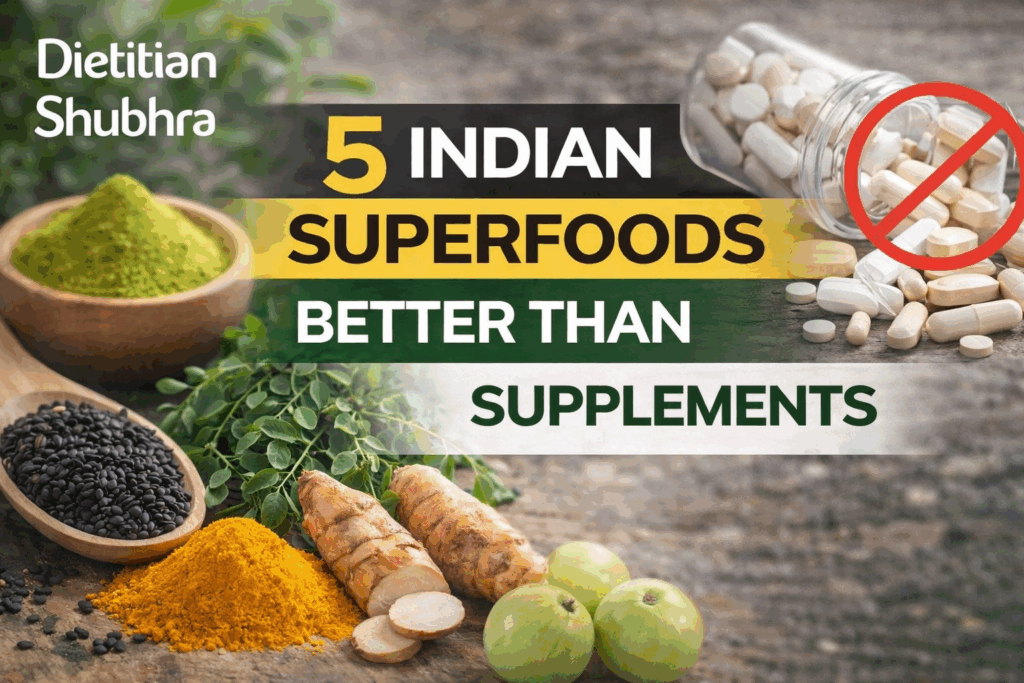
In today’s fast-paced world, supplements have become an everyday habit for all people. Instead of taking natural forms of nutrition, people deliberately choose to take supplements. Although it is not harmful, but makes people severely rely on the pills & capsules to fill their nutritional gaps during their day. But what if some Indian superfoods already offer better nutrition, along with better absorption of those nutrients in the body, with long-term benefits for the body than a supplement? In this blog, we explore the 5 Indian Superfoods Better than Supplements.


Before walking through the list, let’s understand why whole foods are better than supplements:
Supplements should only “supplement your diet”, not replace your nutrient-rich foods.
Here are some of the best Indian superfoods that are considered better than supplements due to their benefits, nutritional value and several other reasons.
Amla, also known as the Indian Gooseberry, which provides essential nutrients, is known to be one of the most powerful superfoods in the world for the human body. It is also a cornerstone of Ayurveda.
Nutritional Benefits of Amla-
Unlike vitamin C supplements that often get flushed out of the human body, Amla’s vitamin C is heat-friendly & has better absorption due to the presence of gallic acid.
Health Benefits of Amla-
Beneficial Ways to Consume Amla-
Turmeric is not just any masala or countertop spice to mix in a dish. It is also a medicinal superfood used for over 4000 years in India. Due to the presence of Curcumin, it helps in:
Nutritional Benefits of Haldi-
Unlike many Curcumin supplements, haldi has better absorption in the human body.
Health Benefits of Haldi-
Beneficial Ways to Consume Haldi-
Moringa comes from a drought-resistant tropical tree called “Moringa Oleifera” which is known as the “Tree of Life”. Eating moringa can overall improve your health. It helps in :
Nutritional Benefits of Moringa-
This is the most nutrient-dense tree in the entire world.
Health Benefits of Eating Moringa-
Beneficial Ways to Consume Moringa-
Desi Cowghee is indeed a superfood, it was mostly mistaken by older people that it causes weight gain. But now that we know the value of it, ghee has been used widely in all parts of the world including India.
Nutritional Benefits of Desi Ghee-
Health Benefits of Eating Desi Ghee-
Beneficial Ways to Consume Ghee-
One of the most underrated India’s superfoods and powerful breakfast. Widely used in cereals, oats etc.
Nutritional Benefits of Ragi-
Health Benefits of Eating Desi Ghee-
Beneficial Ways to Consume Ragi-
Indian superfoods are not magic. They are nutritional solutions backed by both the Ayurveda industry and science. While, supplements may be needed in case of illnes, diseases, medical conditions, relying daily on supplements is not recommended.
Takeaway- A balanced Indian diet is rich in traditional superfoods like those mentioned above and surely can provide better nutrition than supplements. Indian superfoods are not only made for taste, but nutrition.
Indian superfoods work as natural replacements for supplements because they deliver nutrients in a form the body recognizes, absorbs, and utilizes efficiently. Here’s how each superfood directly replaces a commonly consumed supplement.
Most vitamin C supplements contain synthetic ascorbic acid, which offers short-term benefits but is quickly excreted by the body. Amla provides natural vitamin C along with tannins, flavonoids, and antioxidants that slow down oxidation and improve absorption.
How Amla Replaces Supplements:
Unlike tablets that focus only on immunity, amla strengthens the body’s overall defense system, making it a better long-term alternative.
Curcumin supplements are popular but often poorly absorbed unless combined with enhancers. Whole turmeric already contains compounds that work synergistically, especially when consumed with black pepper and fats.
How Turmeric Replaces Supplements:
Instead of masking pain like many supplements, turmeric addresses the root cause of inflammation.
Multivitamin tablets supply isolated nutrients that may not be fully absorbed. Moringa provides a complete spectrum of vitamins, minerals, protein, and antioxidants in their natural form.
How Moringa Replaces Supplements:
Moringa acts as a whole-food multivitamin, reducing the need for daily pills.
Omega-3 capsules often oxidize and lose potency over time. Desi cow ghee provides healthy fats, butyric acid, and fat-soluble vitamins that enhance nutrient absorption and gut health.
How Ghee Replaces Supplements:
Ghee nourishes the body from within, rather than delivering isolated fats through capsules.
Calcium supplements are commonly associated with poor absorption and digestive issues. Ragi offers naturally absorbable calcium, plant protein, and fiber, making it ideal for bone health.
How Ragi Replaces Supplements:
Ragi provides long-term skeletal and metabolic support, not just calcium intake.
At last, superfoods are as necessary for us & should be eaten on regular basis to maintain a healthy weight, body and strength. Supplements should be only taken when it is necessary and not be replaced with food in terms of nutrition.
Q1) Is Moringa only produced in India?
Ans- No, moringa is available worldwide but initially it was an Indian Traditional Superfood
Q2) Is amla expensive?
Ans- Np, Amlas cost same as any normal fruit but definitely offer a lot more nutrition.
Q3) Which of these superfoods helps in Bones & skeletal support
Ans- Moringa and Ragi boosts bone growth and makes them strong due to high content of calcium.
Q4) Which of these Superfoods can be eaten raw?
Ans- Almost, every superfoods listed above can be eaten raw, except for ragi because you won’t have any taste of it.
Q5) Can these superfoods completely replace supplements?
Ans- In most cases, a balanced diet that includes nutrient-dense superfoods like amla, turmeric, moringa, ghee, and ragi can naturally provide essential vitamins and minerals. However, supplements may still be required in certain conditions such as severe deficiencies, pregnancy, or specific medical issues. It is always advisable to consult a healthcare professional before stopping prescribed supplements.
Q6) How often should these superfoods be included in the daily diet?
Ans- These superfoods can be safely included in daily meals in moderate quantities. For example, 1–2 teaspoons of ghee, a serving of ragi in breakfast, turmeric in cooking, amla juice or fruit, and moringa leaves in dishes can provide consistent nutritional benefits and help maintain overall health without relying heavily on supplements.