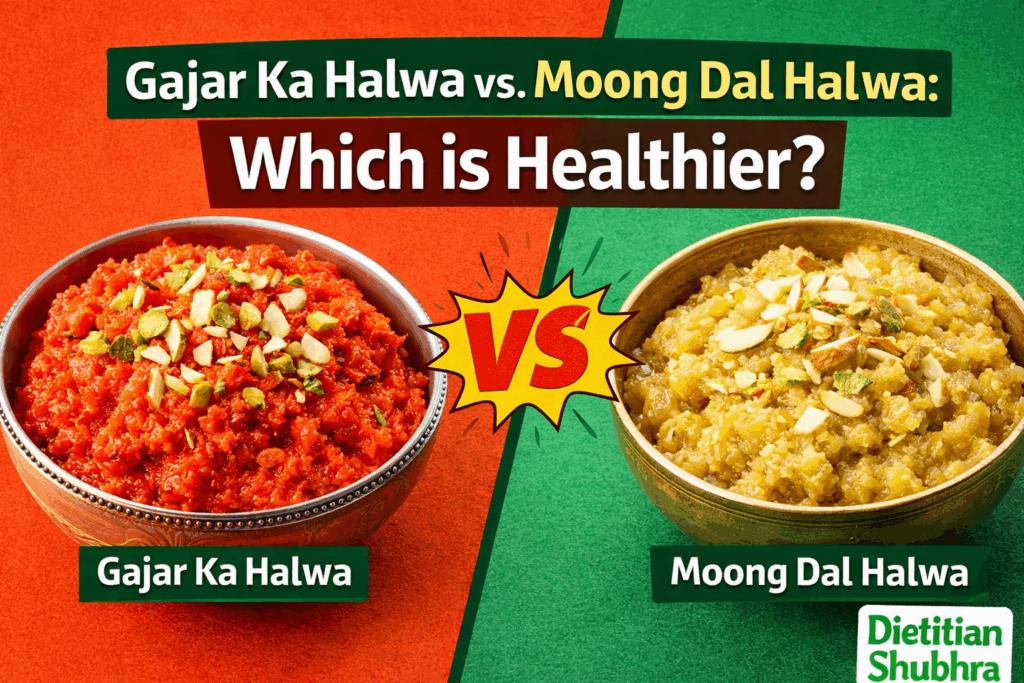
Gajar Ka Halwa and Moong Dal Halwa are two beloved Indian desserts, especially enjoyed during winter and festive occasions. While both offer rich flavor and tradition, they differ in key nutritional aspects. Gajar Ka Halwa is made primarily from grated carrots, milk, sugar, and ghee, supplying energy, vitamins (notably vitamin A from carrots), and fats. Moong Dal Halwa, made from yellow lentils with ghee and sugar, is denser in plant-based protein and can be more satiating. This comparison examines their health profiles to help you choose based on your nutritional goals.

While both of these give you a heightened sense of sweetness and warmth, their health profiles are all about goodness and halwaness. Make sure to have a good read of the blog Gajar Ka Halwa vs. Moong Dal Halwa: Which is Healthier, giving you all the important information about halwvas. More information brought to you by Dietitian Shubhra.
Understanding the right nutritional breakdown, we can choose different proportions, helping with calorie and nutrient intake. Here is a side-by-side breakdown of all that these desserts can bring you, along with joy and warm happiness.
| Nutrient | Gajar ka halwa | Moong dal halwa |
| Energy | 215 kcal | 345 kcal |
| Carbohydrates | 26.5 g | 23.0 g |
| Total Sugar | 18.0 g | 11.0 g |
| Dietary Fiber | 3.1 g | 2.0 g |
| Protein | 3.5 g | 8.2 g |
| Fat | 10.8g | 22.5g |
| Saturated fat | 6.1g | 13.8g |
| Cholestrol | 32mg | 68mg |
From selecting carrots to washing, peeling, grating, and then boiling to remove any dirt or unwanted particles, they take up to a prepping time of 30-35 minutes. With that being said, using a food processor reduces grating time to ~5 minutes; no soaking or resting period is required, and it can be cooked immediately after prep, which might have a good effect on reducing the prepping time, making this one a bit easier on the labour.
Moongdal, on the other hand, sorting & washing dal, soaking it, grinding, resting the paste, chopping nuts, and measuring everything, this can be pretty jarring too. Given that the soaking takes overnight, this can be a hard one to take; the active prep is almost 25-30 minutes. Total elapsed prep time, including soaking, takes 6.5–8.5 hours.
Cooking them’s another story in itself, from the counting of the whistles, to the roasting of the paste, all of it can be tedious. Heat ghee in a heavy-bottom pan and sauté the grated carrots for 8–10 minutes until they soften and release aroma. Add milk and cook on medium heat for 25–30 minutes, stirring occasionally, until the milk reduces and thickens. Add sugar or jaggery and cook for another 8–10 minutes until the moisture evaporates and the halwa thickens. Add cardamom and nuts; cook for 3–5 minutes and turn off the heat.
For moongdal, things are slightly different. It all looks a bit like Heat a generous amount of ghee and add the ground moong dal paste. Roast continuously on low to medium heat for 20–25 minutes until the raw smell disappears and the mixture turns aromatic and golden. Add hot milk or sugar syrup slowly while stirring vigorously to prevent lumps. Cook for another 8–10 minutes until the halwa thickens and the ghee separates. Add cardamom and nuts; cook 2–3 minutes more.
Once the cooking is done and the bowls are served, the real impact of these halwas is felt in how they affect the body, energy levels, digestion, and overall well-being. Both Gajar Ka Halwa and Moong Dal Halwa are deeply satisfying desserts that provide warmth, comfort, and a sense of indulgence. However, their nutritional density and richness mean they influence the body differently after consumption
Both Gajar ka halwa and moong dal halwa offer distinct health benefits based on their primary ingredients and nutrient profiles. Gajar ka halwa, made mainly from carrots and primary ingredients, and nutrient-rich, is rich in beta-carotene, which supports eye health, skin repair, reduces bloating, and supports heart health. It also provides dietary fiber and potassium, helping in many other ways as well. Its antioxidant content helps reduce oxidative stress, making it a comparatively lighter and more micronutrient-focused dessert.
Moong Dal Halwa, on the other hand, is a protein- and energy-dense sweet. It supplies high-quality plant protein, iron, folate, magnesium, and phosphorus, which support muscle repair, hemoglobin formation, bone strength, and sustained energy levels. Due to its higher fat and calorie content, it is more satiating and beneficial for people needing weight gain, recovery nutrition, or higher energy intake.
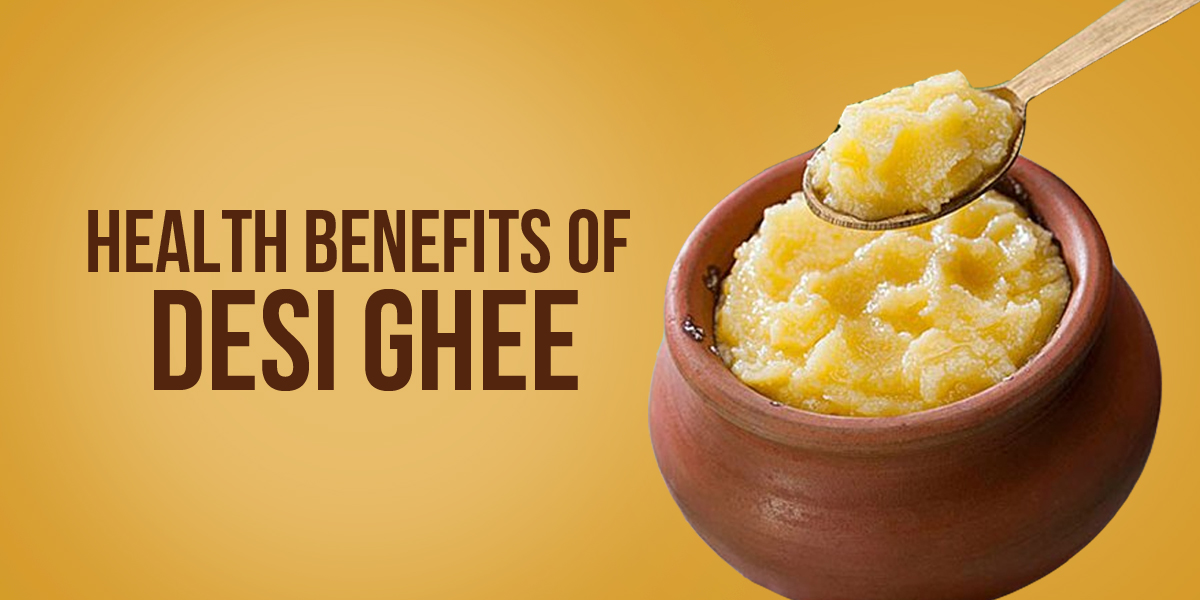
Gajar ka halwa gives you the warm fuzzy feeling with the milk solids and the dry fruits, while the moong dal halwa comes in with oil and all the sweet memories you must’ve made with your family, making or eating them. Below are some of the health considerations one should keep in mind while consuming both foods.
To make classic Indian halwas healthier without sacrificing flavor, small but intentional changes in ingredients and preparation can significantly reduce calories and saturated fat. For Gajar Ka Halwa, use skimmed or low-fat milk instead of full-cream, cut down on refined sugar (or substitute jaggery or dates), and limit ghee to a drizzle while enhancing aroma with cardamom and nuts instead of extra fat. For Moong Dal Halwa, reduce sugar, use moderate ghee, and roast the lentils beforehand to deepen flavor with less fat. Additionally, portion control and natural sweeteners help maintain sweetness with fewer calories.
We hope to have given all the required information to have the best time-consuming reading about them, prepping them, and cleaning after them. For more such information, contact Dietitian Shubhra.
What are Gajar Ka Halwa and Moong Dal Halwa?
Gajar Ka Halwa is an Indian dessert made from grated carrots cooked with milk, sugar, ghee, and nuts. It is known for its sweet taste and rich texture. Moong Dal Halwa is prepared from split yellow moong dal (lentils), ghee, sugar, and often milk or khoya, resulting in a dense, rich dessert. Both are traditional festive sweets, especially popular in winter.
How many calories do these halwas typically have?
Calorie content varies widely by recipe and portion size, like Gajar Ka Halwa, which generally has roughly 250–400 kcal per 100 g due to sugar, milk, and ghee. Moong Dal Halwa can be around 280–420 kcal per ~100 g serving, with additional fat and protein from lentils and ghee.
Which halwa has more protein?
Moong Dal Halwa tends to have higher protein because moong dal is a legume with plant-based protein, often providing around 8–12 g of protein per 100 g. Gajar Ka Halwa typically has moderate protein from milk and nuts, but somewhat less than the moong dal versions.
Does one halwa offer specific health benefits?
Gajar Ka Halwa delivers Vitamin A (beta-carotene) from carrots, which supports vision and immunity, and antioxidants from carrots and nuts.
Moong Dal Halwa provides plant-based protein and some fiber, supporting muscle health and satiety.
Which one is better if I’m watching my weight?
Both are calorie-dense and rich in sugar and fat; moderation is key. A slightly lower-calorie Gajar Ka Halwa with more carrots and less ghee/sugar might be easier to manage in a calorie-controlled diet than a traditionally rich Moong Dal Halwa. Regardless, portion size matters more than choice alone.
Are these halwas good for people with diabetes?
Both halwas are high in sugar and carbohydrates, which can impact blood glucose. People with diabetes should either avoid them or choose reduced-sugar versions and control portions carefully. Made with natural sweeteners and lower ghee/milk fat, they may be easier to include occasionally.
Can these desserts be part of a balanced diet?
Yes, in moderation. Used in small portions during feasts or as part of an overall balanced eating plan, they can be enjoyed without major health compromises. Making lighter versions using low-fat milk, less sugar, or natural sweeteners can help.